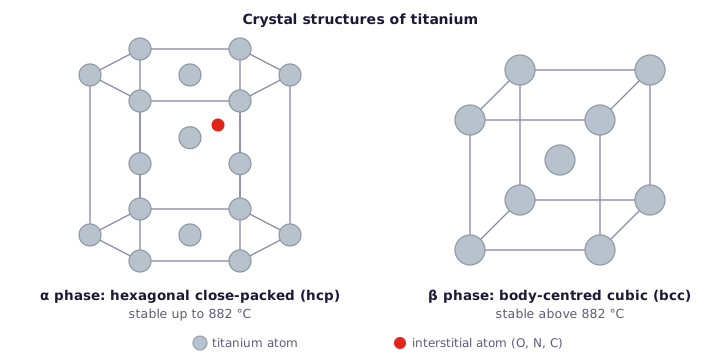
Titanium has a density of 4.51 g/cm³, about 57% of that of steel, and an elastic modulus of about 105 GPa, half that of steel: it therefore offers a very high strength-to-weight ratio and great elastic flexibility. Up to 882 °C the α phase, with a hexagonal close-packed lattice, is stable; above that temperature it transforms into the body-centred cubic β phase.
The two allotropic forms of titanium. Commercially pure grades are used in the α condition.
What distinguishes the grades
Commercially pure grades are not alloys: they differ in their content of interstitial elements, above all oxygen, and of iron. Small oxygen atoms occupy the octahedral interstices of the hexagonal lattice and hinder dislocation glide (interstitial solid-solution strengthening): more oxygen means higher strength and lower ductility.
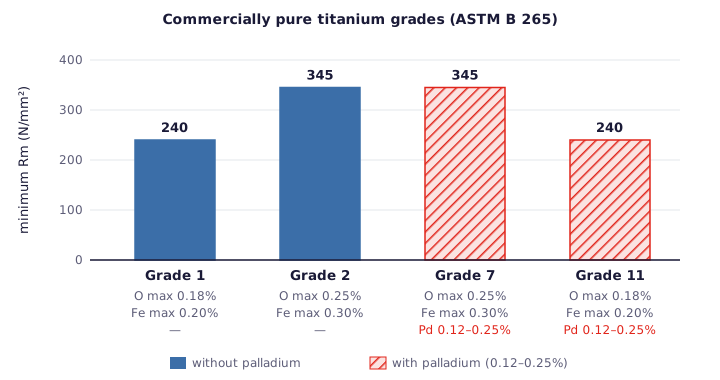
Grade 1 (O ≤ 0.18%): the softest and most ductile, ideal for deep drawing and severe forming.
Grade 2 (O ≤ 0.25%): the most widely used balance between strength and formability.
Grade 11 and Grade 7: the same base as Grade 1 and Grade 2, with the addition of 0.12–0.25% palladium.
Minimum tensile strength and composition limits of the four grades.
Why it resists corrosion
Titanium is a very reactive metal, and precisely for this reason it instantly becomes covered with a TiO₂ film a few nanometres thick and extremely stable. In seawater, chloride solutions, oxidising acids and biological environments its corrosion rate is practically zero; titanium is also biocompatible. Its weak points are reducing acids (hydrochloric, sulphuric) and crevice corrosion in hot chlorides, where the film can dissolve and the metal corrodes actively.
The effect of palladium (Grades 7 and 11)
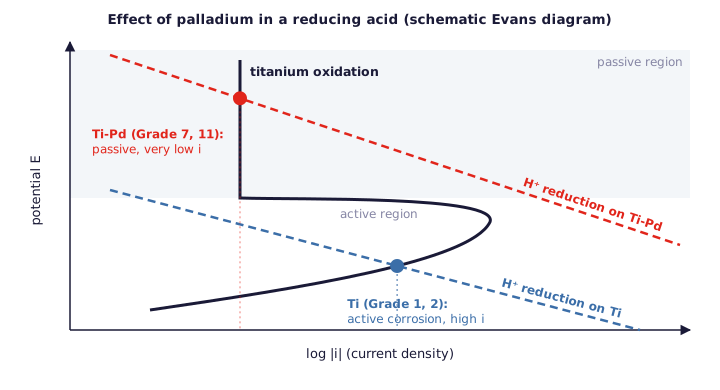
Palladium, even in small amounts, accumulates on the surface and catalyses the reduction of hydrogen ions. The cathodic reaction becomes much faster and shifts the corrosion potential from the active to the passive region: the TiO₂ film remains stable even in reducing acids and in crevices. This is known as cathodic modification.
With palladium, the intersection of the curves, i.e. the operating point, falls in the passive range.