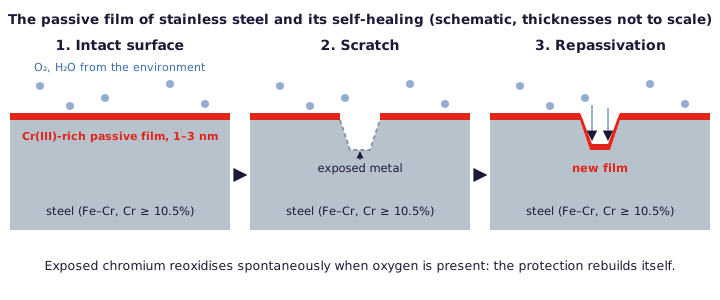
Under EN 10088-1, a steel is stainless when it contains at least 10.5% chromium and no more than 1.2% carbon. Chromium has a greater affinity for oxygen than iron: in contact with air or water it forms on the surface a film of Cr(III)-rich oxides and oxyhydroxides only 1–3 nanometres thick. The film is compact, adherent, transparent and practically insoluble: it separates the metal from the environment and lowers the corrosion rate by several orders of magnitude. This is passivity.
The film is not an applied coating but a property of the alloy: if it is scratched or abraded, the exposed chromium reoxidises spontaneously when oxygen is present and the protection rebuilds itself (self-passivation).
The passive film re-forms by itself after mechanical damage.
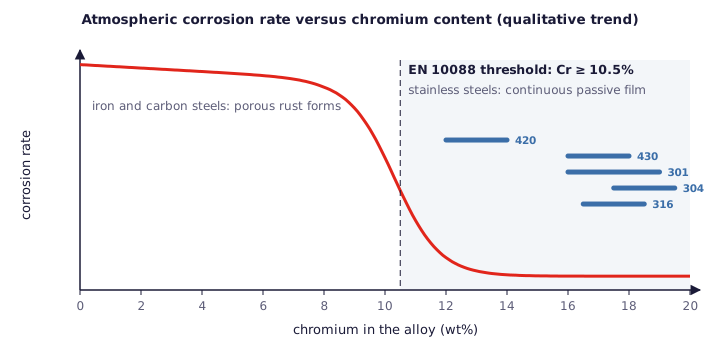
Below 10.5% chromium the film is discontinuous and porous rust forms, which offers no protection; above the threshold the atmospheric corrosion rate drops sharply.
Corrosion resistance changes abruptly at around 10.5% chromium. The bars show the chromium ranges of the Lamina grades.
The role of the other elements
Nickel – stabilises austenite, the face-centred cubic lattice: steels with enough nickel (301, 304, 316) are ductile, tough even at low temperature and non-magnetic in the annealed condition.
Molybdenum – strengthens the passive film against chlorides, and therefore against pitting and crevice corrosion: this is why 316 performs better than 304 in marine environments or in contact with salts.
Low carbon (“L” grades, C ≤ 0.03%) – between about 450 and 850 °C, for example in the heat-affected zone of a weld, carbon combines with chromium to form Cr₂₃C₆ carbides at the grain boundaries. The adjacent chromium-depleted zones lose their passivity (sensitisation) and may suffer intergranular corrosion. 304 L and 316 L drastically reduce this risk.
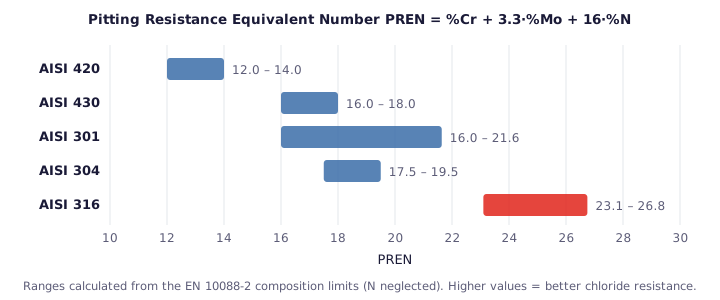
A practical index for comparing pitting resistance is the PREN (Pitting Resistance Equivalent Number).
Molybdenum lifts 316 clearly above the other grades.
Three structures, three behaviours
Family
Grades
Structure
Main characteristics
Austenitic
301, 301 Mo, 304, 304 L, 316, 316 L
face-centred cubic
Non-magnetic when annealed, excellent formability and weldability. In 301, which is leaner in nickel, the austenite is metastable: during cold rolling it partly transforms into α′ martensite, and the strip reaches very high strength (hard tempers for springs).
Ferritic
430
body-centred cubic
Nickel-free, magnetic, good resistance to chloride stress corrosion cracking.
Martensitic
420
martensite (after hardening)
Higher carbon, hardenable: high hardness and wear resistance, for blades and tools.