Nickel has a face-centred cubic lattice and undergoes no phase transformation from cryogenic temperatures up to melting (1455 °C): it remains ductile and tough over this whole range. Its alloys cannot be hardened by heat treatment: strength is set by composition (solid solution) and by the degree of work hardening from cold rolling.
Nickel 201 (2.4061): low-carbon pure nickel
It contains at least 99% nickel. It has excellent resistance to caustic alkalis, even concentrated and hot (caustic soda), and to dry halogen-bearing atmospheres. It has high electrical and thermal conductivity, is ferromagnetic (Curie temperature about 358 °C) and magnetostrictive: this is why it is used in the chemical industry, in electronics and in battery connections.
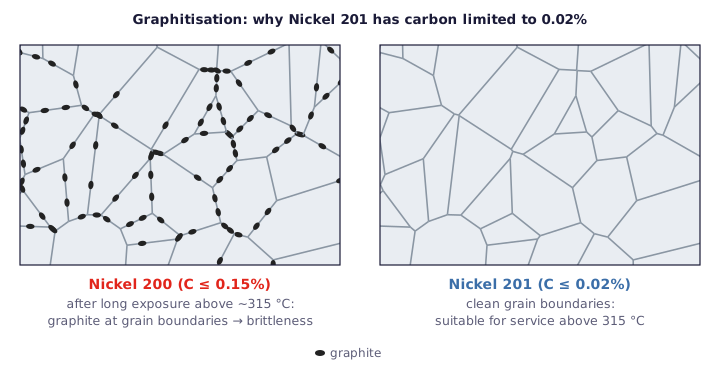
Compared with Nickel 200, carbon is limited to 0.02%. In Nickel 200, if the material is held for long periods above about 315 °C, the excess carbon precipitates as graphite at the grain boundaries and makes it brittle (graphitisation). Nickel 201 is therefore the choice for high-temperature service.
The low carbon content of Nickel 201 prevents graphite precipitation.
Monel 400 (2.4361): nickel–copper alloy
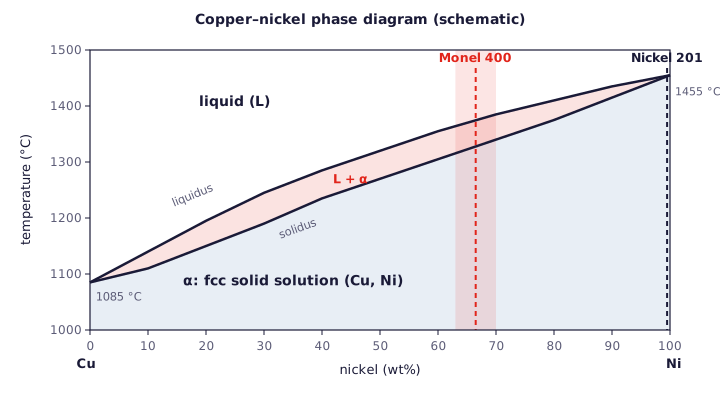
It contains about two thirds nickel and one third copper (Cu 28–34%), with small amounts of iron and manganese. Nickel and copper share the same face-centred cubic lattice, almost identical atomic radii and similar electronegativities (Hume-Rothery rules): they are miscible in all proportions and form a single solid solution, as the phase diagram shows.
Copper and nickel are completely soluble in the solid state.
The result is an alloy stronger than pure nickel, very ductile and weldable, with outstanding corrosion resistance in seawater (even flowing at high velocity), hydrofluoric acid, dilute reducing acids and alkalis. Its Curie temperature is close to room temperature, so Monel 400 is only weakly magnetic.